St. John’s Lutheran Church
Albany, New York
22 November 2026 + The Third Sunday of Advent: Christ the King
Proper 29 / Lectionary 34a
Matthew 25:31-46
The Rev. Josh Evans
Church names carry meaning –
especially those having to do with Jesus:
Good Shepherd.
Messiah.
Our Redeemer.
Prince of Peace.
Emmanuel.
Christ the King.
Each of them tells us something
about who Jesus is –
and, notably, they’re all positive images.
I can’t say I’ve ever seen
a Crucifixion Lutheran Church
or the Episcopal Church of the Cleansing of the Temple.
But each of them is, nonetheless,
an important part of the story.
Each of them tells us something important
about who Jesus is.
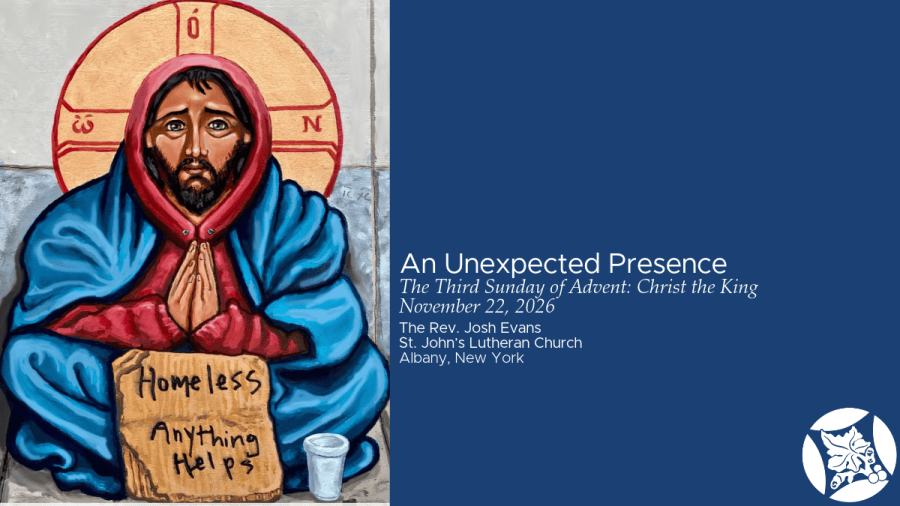
The image
of a hungry,
thirsty,
outsider,
naked,
sick,
and imprisoned
Jesus
is unexpected –
not exactly the first image we’d choose,
least of all for a king –
and it is Jesus’ own self-description
in the story he tells today.
American author Flannery O’Connor once wrote,
“A story is a way to say something
that can’t be said any other way,
and it takes every word in the story
to say what the meaning is.
You tell a story
because a statement would be inadequate.”
The same could be said of Jesus’ parables.
A parable is a way to say something
that can’t be said any other way.
Jesus tells stories
because a statement would be inadequate –
not to mention boring.
Jesus could’ve easily replaced this week’s parable –
his last in Matthew’s gospel –
with a series of statements,
just another teaching:
Feed the hungry.
Welcome the stranger.
Clothe the naked.
Care for the sick.
Visit the imprisoned.
But we only have to look back at the Ten Commandments
and the history of God’s people
to see how well we do with direct statements.
And how many of us like being told what to do?
But a good story?
Well, that’s a different…story.
People are much more compelled
by a good story.
In one of Flannery O’Connor’s well-known short stories, “Revelation,”
we meet Mrs. Ruby Turpin,
who has brought her husband in for a doctor’s appointment.
Immediately upon entering the waiting room,
Mrs. Turpin “sizes up” the place –
and all the people in it.
It quickly becomes apparent that Mrs. Turpin
is incredibly judgmental and critical –
not to mention racist.
When there’s only one seat available,
she graciously insists that her husband,
who has a leg ulcer, take it –
while vocally drawing attention to the fact
that she remains standing.
As the waiting room scene unfolds,
we learn through her own inner – and outer – dialogue
that the insufferable Mrs. Turpin fancies herself superior.
She insists she has a “good disposition” and “a little of everything,”
and that makes her better than most of the people around her –
though clearly her words and actions say otherwise.
Only one fellow patient in the waiting room, Mary Grace,
seems to see right through her facade –
as she stares, angrily and silently, at Mrs. Turpin…
until she finally snaps, throws her book,
hitting Mrs. Turpin square in the face,
and lunges out of her seat to attack her.
In the hectic scene that ensues,
Mrs. Turpin asks her now-restrained assailant,
“What you got to say to me?”
Speaking for the only time in the whole story,
Mary Grace locks her gaze with Mrs. Turpin’s
and deliberately responds,
“Go back to hell where you came from, you old wart hog.”
Mrs. Turpin is visibly flustered and disturbed
by Mary Grace’s harsh indictment,
and when the story eventually reaches its climax,
she has a vision – a revelation:
“a vast horde of souls were rumbling toward heaven.”
All the people Mrs. Turpin thought herself better than
lead the procession,
and people like herself
bring up the end.
Mrs. Turpin’s revelation is jarring
and unexpected.
The very people she thought she was better than
are the ones going ahead of her into heaven.
It’s a reversal that comes as a harsh judgment.
It’s also an experience of grace.
As O’Connor has said of her work,
“All of my stories are about the action of grace
on a character who is not very willing to support it.”
Mrs. Turpin’s experience
and the parable Jesus tells
are like that –
intertwined stories of judgment and grace
that show us something we need to see.
Mary Grace’s words pierce through Mrs. Turpin’s worldview
and eventually lead her to experience a vision
of who is included in the kingdom of God.
Jesus’ words are like that too.
They pierce through a limited worldview
of where we have come to expect Jesus to show up,
or at the very least in the tidy places where we’d prefer to keep him.
There is judgment in this parable –
but there is also grace.
A powerful, searing grace
that invites us into an ever more expansive view
of the kingdom of God.
It’s a parable of reversals –
upending our expectations
of where Christ is.
Christ is with the hungry and the thirsty,
the stranger and the outcast,
the naked and the sick,
the imprisoned and the detained.
Christ is with each beloved child of God
whose stories we heard on Friday night
at our annual Transgender Day of Remembrance memorial service.
Christ is with each parent, each child, each loved one
taken from their homes, from their families,
from their workplaces, and from their schools,
and detained by ICE.
Christ is with you who mourn,
with one less place setting at the Thanksgiving table this year.
Christ is with you who are lonely,
or anxious, or afraid, or newly diagnosed.
Christ, Emmanuel, God-with-us,
is with you
and calls you blessed,
just as he did in those words of blessing,
twenty chapters ago,
that started it all:
Blessed are you:
for you will be comforted,
for you will be filled,
for you will receive mercy,
for you will take your place in God’s kingdom,
for you, a beloved child of God, will see God –
right there with you, through it all.
Over and over again,
Matthew upends our expectations,
telling us more of the story,
showing us who and where Christ is.
Christ the King –
not in a gilded palace or ballroom,
but with the kicked out, discarded,
isolated, and marginalized.
Christ the King –
in the places of despair
and hopelessness
and death,
bringing life
and blessing
and resurrection –
a thrill of hope
for our weary souls.
Christ the King –
in the image of the hungry,
the thirsty,
the outsider,
the naked,
the sick,
and the imprisoned,
each revealing something
of who Jesus is.
A surprising,
grace-filled,
and unexpected
presence.

