St. John’s Lutheran Church
Albany, New York
18 October 2026 + The 21st Sunday after Pentecost
Proper 24 / Lectionary 29a
Matthew 22:15-22
The Rev. Josh Evans
“When the chief priests and the Pharisees heard [Jesus’] parables,
they realized that he was speaking about them.
They wanted to arrest him,
but they feared the crowds…”
And so, before too long,
one parable later,
the Pharisees send their disciples back,
this time with their “friends” the Herodians –
an unlikely alliance
if ever there were one.
The Pharisees,
who generally opposed the rule of the Roman Empire,
and the Herodians,
who were in cahoots with Rome –
working together around a common cause (isn’t that sweet?):
to trap Jesus.
“Is it lawful to pay taxes to Caesar or not?”
they ask,
after buttering him up
with a little over-the-top “praise.”
If he says yes,
he’ll piss off the Pharisees
and, more importantly, those pesky crowds
who won’t let us arrest him.
If he says no,
he’ll piss off the Herodians –
not to mention get himself in hot water
with the Roman authorities.
Lose-lose for Jesus,
but win-win for the interrogators –
after all, they’re not the ones on the hook.
They just asked the question –
so sincere in their intentions.
Hardly.
Jesus knows exactly who is questioning him
and, “aware of their malice,” sees right through their flattery:
“Why are you putting me to the test, you hypocrites?”
Jesus knows they each have their preferred answer already,
and he also knows how they each would compromise their own agendas
whenever it happened to be convenient.
For them, it isn’t a matter of validating
one side of the aisle or the other.
It’s about trapping Jesus –
and ending him.
Hypocrites.
“Show me the coin used for the tax,”
Jesus innocently asks –
which is to suggest
that he doesn’t have one…
but they do!
(Interesting…)
On the one hand,
Jesus’ answer is surprisingly simple,
beginning with another question:
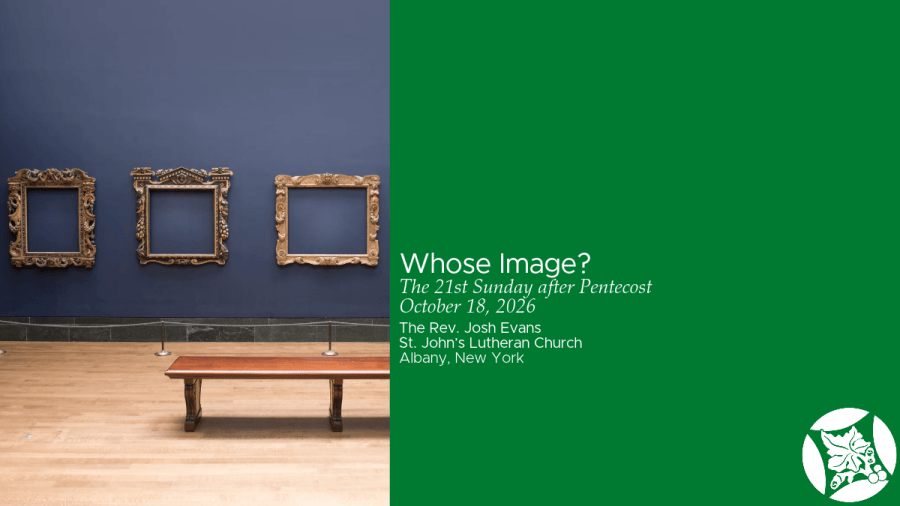
And whose head [eikon = image] is on this coin?
Caesar’s? Cool.
Then give it to Caesar,
and pay your taxes.
But that’s only half the answer.
“Give therefore to Caesar the things that are Caesar’s” –
the coins that bear his image –
“and to God the things that are God’s” –
and what exactly bears God’s image?
Jesus doesn’t fully make the connection,
but our biblical and theological tradition certainly does.
Then God said,
“Let us make humans in our image [eikon],
according to our likeness…”
And so God did.
That’s a pretty remarkable thing.
What bears God’s image?
Humanity.
Before anything else,
this is our starting place:
image-bearers of God.
And so, Jesus tells them:
Give yourselves (back) to God.
As Luther prays
in his well-known morning and evening blessings,
“Into your hands I commend myself:
my body, my soul, and all that is mine.”
The second half of Jesus’ answer is a reminder
of the God who has formed us
and a call to live like the image-bearers
of that God.
This is not a simple accounting –
divvying up coins into one pile for Caesar/the IRS
and into another for God/the church –
although that would be a pretty good cut-and-dried sermon
for stewardship season, wouldn’t it?
Caesar’s kingdom and God’s kingdom
are two radically different things –
and the “coinage” too is of a radically different nature.
Give the coin to Caesar,
and give yourself to God.
Which is to say:
This is an invitation to participate fully in God’s mission,
to privilege God’s kingdom above all else,
to love God with all your heart and soul and mind –
as we will hear in next week’s gospel –
and to love your neighbor as yourself,
which will necessarily mean opposing
the kingdom of Caesar
that privileges only itself.
The way of resistance,
Jesus seems to suggest,
is not withholding the coin used for the tax.
Navigating political spaces within oppressive regimes
is far more complicated than that.
The way of resistance
is the way of God,
remembering that our highest and ultimate loyalty
is to the God in whose image we are made
and who entrusts us with the care of God’s creation:
to oppose inordinate cruelty with extraordinary mercy,
self-serving arrogance with self-emptying humility,
and the thirst for power with the thirst for justice –
seeking the wellbeing of all.
We may not live in first-century Palestine
where the question of paying taxes to the Roman Empire or not
is our chief concern.
But we do know something of what it’s like
to live in a society where political factions
are deeply at odds with one another,
where questions seek not to understand
but to trap and humiliate.
And Jesus’ answer has as much to say to us
as to the Pharisees and Herodians.
Jesus calls us back
to the One in whose image we are made
and whose image we bear.
That is our starting place:
beloved children of God,
claimed in the waters of baptism,
sealed by the Holy Spirit
and marked with the cross of Christ forever –
an image and an identity
that no empire, no regime, no ruler
can ever take away.
Each of us –
lovingly made in the image of God.
Even the ones who seek to trap Jesus,
who walk away amazed.
Even Caesar.
Each of us –
beloved.
Even (the people you’re thinking of now).
This is our starting place.
And when this is our starting place,
our bitter divisions and hostilities are reframed –
which is not to say they don’t matter
or that we can just ignore them,
especially when the dignity and care of our neighbors
are on the line –
but it is to give the greater emphasis
to God’s creative work.
As we navigate the spaces in which we find ourselves
and the times in which we live,
amid all the “changes and chances” of life,
whatever life brings,
this is our starting place:
We are made in God’s image.
We belong to God.
And God invites us to participate
in God’s creative, redeeming, and liberating work:
to give ourselves to God
and to one another
in loving service –
a living witness to the One
who gives himself for us.

