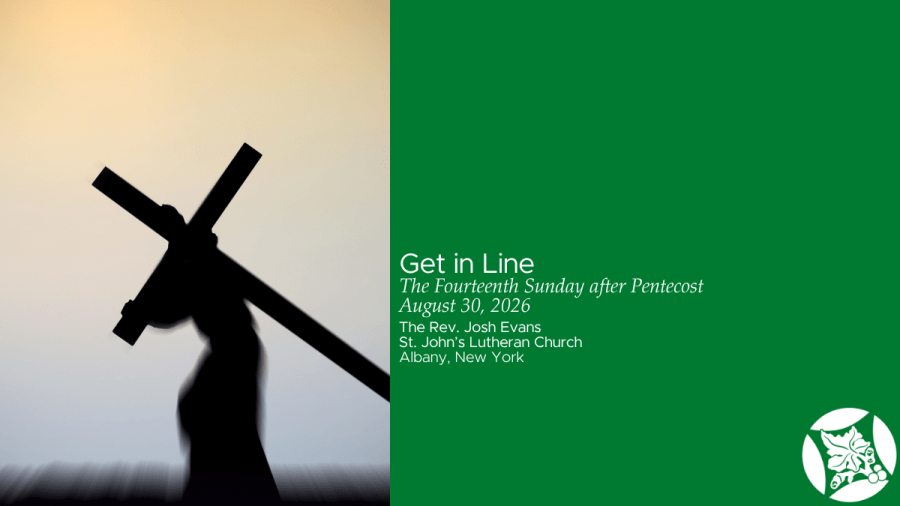
St. John’s Lutheran Church
Albany, New York
30 August 2026 + The Fourteenth Sunday after Pentecost
Proper 17 / Lectionary 22a
Matthew 16:21-28; Romans 12:9-21
The Rev. Josh Evans
How could Peter have gotten it so right
and then, in the next breath, so wrong?
Peter’s stunning confession
and then his spectacular failure in the face of Jesus’ harsh rebuke
are actually not back-to-back scenes,
despite being two halves of the same chapter,
flowing directly from one verse to the next.
Matthew’s own transition line –
“from that time on” –
suggests movement
through time and place,
physical journeying
and mental processing.
How much time and distance
have elapsed
isn’t known,
but the point is, simply,
Peter had time and space to think –
and we all know what happens
when we’re left alone with our thoughts.
For me, there’s always been something
about physical movement –
often on long walks without a particular destination in mind –
that spurs thinking, mental processing
about something that has taken place,
and/or something that is to come.
Most often, this serves to help me sort out
and make sense of things –
but other times, it heightens my anxieties.
Sometimes, it’s a mix of both.
I wonder if that’s what it was like for Peter.
Peter, who knew what Jesus was capable of.
Peter, whose even “little faith” enabled him to walk on water with Jesus.
Peter, who didn’t pull his confession out of thin air,
but finally gave words to all he had experienced
after all this time with Jesus
and what he had come to know to be true:
“You are the Messiah, the Son of the living God!”
But Peter also had his own ideas –
and time and space to think and process.
He had his own interpretation of this Messiah,
rooted in the stories of his faith and his people’s history
about Messiah-like figures who led mighty revolts
against their oppressors and their enemies.
Peter – like others of his time – had a vision for a Messiah
who would take up arms against Rome,
lead the charge,
and prove themselves victorious over the powers of the empire.
Peter had it all worked out.
You can imagine the faint smile
brought on by wishful daydreaming,
as he was walking along –
maybe ahead of the rest of the group with a renewed resolve,
or maybe dawdling behind, wistfully imagining better days –
when all of a sudden
he catches a few words of what Jesus is saying:
“ … undergo great suffering … be killed … “
“What’s this?” –
perking up from his daydream –
“God forbid it, Lord! This must never happen to you!”
Peter says, running up to Jesus,
winded,
desperate,
pleading.
Then Jesus turns…
toward Peter, as he was coming up from behind him?
Or away from Peter, turning his back on him
so as to physically illustrate the point: “Get behind me, Satan!”
Get behind me, you who are an adversary to God’s reign,
a hindrance and a stumbling block.
When it came to the Messiah,
Peter had one thing in mind.
Jesus had another.
And he continues his teaching:
“If any wish to come after me,
let them deny themselves
and take up their cross
and follow me.”
The Messiah as Peter expected it –
and probably the rest of the disciples too –
the Messiah following the predictable and conventional patterns
and ways of this world
is not the Messiah of God’s reign,
as Jesus spells it out.
The Messiah of God’s reign
that Jesus embodies
does not mean a conquering king
or domineering, vengeful, power-hungry, petty, insecure tyrant. (Sound familiar?)
The Messiah of God’s reign
subverts all predictability,
all conventional patterns.
Instead of dominance and destruction,
the Messiah of God’s reign
offers a different way,
marked by humility, healing, and liberation.
Which is not to say
the life of a follower of that Messiah
is without its challenges –
indeed, it is the way of the cross.
As the late theologian James Cone puts it,
as I’ve often quoted in sermons before,
“If you are going to worship somebody that was nailed to a tree,
you must know that the life of a disciple of that person
is not going to be easy.”
Which is not to excuse suffering
or go out looking for it,
or to tolerate abuse or injustice.
Jesus did not say
“go out and find a cross,”
but “take up your cross” –
which to say that suffering already exists,
and so the imperative is instead,
as one commentary puts it,
“to seize the role of active protagonist in the drama,
not the role of a defeated victim;
and then to follow Jesus along the way
that leads to health, liberation, and new life.”
The Messiah of God’s reign
walks the way of the cross,
and the way of the cross in God’s reign
leads to life.
I wonder if Peter didn’t catch that part
in his daydreaming and half-listening (or selective hearing):
“ … undergo great suffering … be killed …
and on the third day be raised.”
When it came to the Messiah,
Peter had one thing in mind:
a Messiah who would conquer
by might and force,
or at the very least not be killed.
Jesus had another interpretation in mind:
a Messiah who empties himself,
who shows his love in humility, in service,
in solidarity with the poor and oppressed,
in dying for his friends –
and in rising
for the life of the world.
“Get behind me, Satan!”
might also not be the harsh rebuke we assume it is –
although it certainly must have gotten Peter’s attention –
but perhaps instead an invitation:
“Get in line behind me.”
Reorient your priorities in line with God’s reign
and God’s Messiah:
Love one another,
and let love be genuine.
Pursue hospitality.
Rejoice with those who rejoice,
and weep with those who weep.
Feed your enemies.
Do not be arrogant.
Overcome evil with good.
“Get in line behind me.”
Take the place of a disciple.
Follow me.
Stop trying to control where this road is going –
because you can’t –
not as a directive to mindlessly follow
but to trust –
trusting that one leading
is leading us to life,
leading us to God’s reign
of love, liberation, and wholeness.

