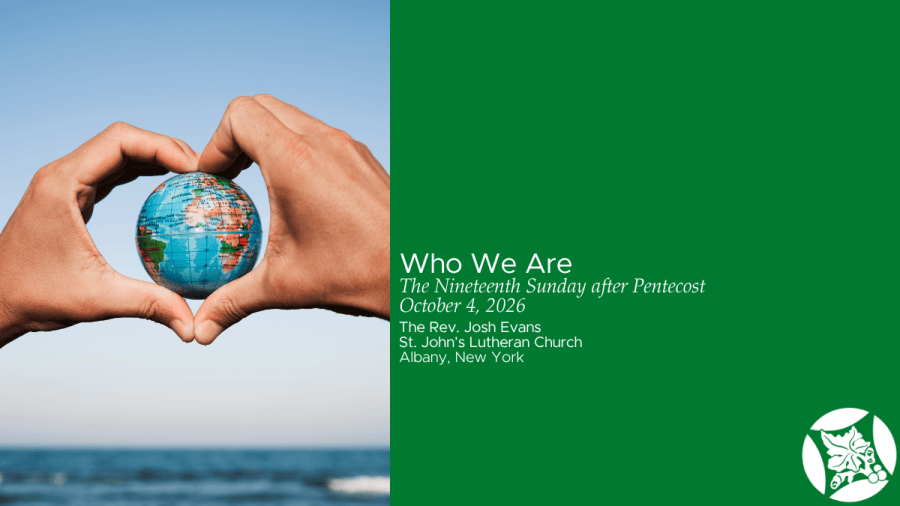
St. John’s Lutheran Church
Albany, New York
4 October 2026 + The Nineteenth Sunday after Pentecost
Proper 22 / Lectionary 27a
Matthew 21:33-46
The Rev. Josh Evans
You know the story:
When God began to create
the heavens and the earth,
the earth was complete chaos…
And slowly, step-by-step, day-by-day,
God spoke into the chaos:
“Let there be light,” and there was light…
to illumine the darkness –
quite frankly, or so I imagine,
so God could see what on earth they were doing.
“Let there be a dome in the midst of the waters…” –
the waters which, curiously, were already there,
even more ancient than creation itself –
“…and let the dome separate the waters…”
creating an expanse to contain the world
as it was coming into being.
“Let the waters under the sky be gathered together into one place,
and let dry land appear…”
already anticipating the diversity of life
that would inhabit each part.
First: “Let the earth put forth vegetation…”
plants and trees and their fruits and seeds,
for the nourishment of creatures yet to come.
“Let there be lights in the dome of the sky
to separate the day from the night…”
ordering time into days and years,
and seasons by which to tend to the vegetation.
And then it starts to really pick up:
“Let the waters bring forth swarms of living creatures,
and let birds fly above the earth across the dome of the sky…”
sea monsters (did anyone bring one of those today?!) and winged birds
and every living creature that moves
and swarms through the waters:
“Be fruitful and multiply!”
Then it was time for the land creatures:
“Let the earth bring forth living creatures of every kind…”
cattle and creeping things
and wild animals of every kind.
At each step, with each day,
God spoke life into being,
ordering chaos,
creating community –
creation itself
an act of gracious generosity and hospitality,
fashioning a welcoming home for all creatures.
And then, finally:
“Let us make humans in our image…” –
in the image of a gracious, caring, and generous host –
“and let them have dominion…” –
not as a kind of domineering ownership,
but as stewards,
gracious, caring, and generous,
fashioned in the image of God.
This is who we are:
beautiful creatures made in the image
of a gracious, caring, and generous God.
And this is who we are called to be:
gracious, caring, and generous stewards
of a beautiful creation.
You might be wondering what any of this has to do
with the so-called “Parable of the Wicked Tenants” –
and so was I.
It’s not exactly the first passage of Scripture that comes to mind
for a service focused on creation in the midst of creation,
but when we look at the vineyard entrusted to the tenants
against the backdrop of creation,
some noteworthy threads emerge.
While many of Jesus’ parables are dense
and their meaning often eludes his hearers,
in this case, the chief priests and Pharisees immediately realize:
He’s talking about us.
We’re the tenants.
This parable is an indictment
of the religious leaders of Jesus’ day
who abused their authority
and oppressed those under their power.
They had been called to care for their people –
to love their neighbors –
but instead they treated them with contempt and harm,
rejecting the prophets who called them to account and repentance.
To be perfectly clear,
this is not to justify anti-Semitism or supersessionism,
as this parable has often been interpreted,
resulting in anti-Jewish rhetoric.
That history of interpretation is important to name
and to denounce,
especially for those of us who claim the theological heritage of Luther,
whose own harmful writings against the Jewish people
have been used to perpetuate harm and justify egregious acts of violence.
Such an interpretation is not faithful to the text –
and conveniently ignores the fact that Jesus himself was devoutly Jewish.
Back to the parable:
It also strikes me as an indictment
of the perils of ownership –
when “dominion” is misconstrued
as domineering and selfish,
looking out for our own interests,
everyone else – and our planet – be damned.
What the tenants fail to understand –
or perhaps outright ignore –
is that they are tenants –
stewards entrusted to care for that which does not belong to them.
But they get greedy and power-hungry,
and their greed drives them to increasingly egregious acts of violence.
Through the lens of creation care,
it’s not all that difficult to find our place in the parable:
He’s talking about us.
We’re the tenants.
“The Bible’s opening story tells us that everything is divinely created,”
summarizes biblical scholar Amy-Jill (“AJ”) Levine,
“and everything is good: sea and air, plants and animals.
This beginning should be a prompt for us to take care of God’s creation.
Generally, if we want to show appreciation for the good gifts we are given
(especially if we love the one who gave us those gifts),
we take care of what we are given.”
(Genesis, p. 2-3)
But we also know what comes next:
Curiosity, maybe even hubris, gets the better of the first humans,
and soon enough, they become like God,
knowing good and evil –
and they get themselves kicked out of Eden.
It is from this story
that we get the traditional Christian doctrine of “original sin,”
but as AJ points out,
as those of you currently in Bible study will recall,
that’s not explicit in the text.
Instead of original sin,
AJ suggests original opportunity,
as the first humans move from innocence to maturity,
realizing responsibility for their actions.
After their act of disobedience,
God matter-of-factly details the consequences,
beginning with the serpent,
then the woman,
and finally the man.
Of course, Genesis is not literal historical record.
It is an origin story,
describing how the things we humans experience
have come to be.
Again, AJ summarizes:
“This story of human origins is one view
of how things came to be –
the difficulties of life,
the extra work mothers have,
the concern to find the person who completes us,
and the difficulties such relationships create;
it is not prescriptive of how things must be.”
(Genesis, p. 27)
This is not the way things have to be.
There is good news in that –
an opportunity to return to our God-given identity and purpose:
beautiful creatures made in the image
of a gracious, caring, and generous God,
called to be gracious, caring, and generous stewards
of a beautiful creation.
The tenants in the parable
exploited the land and the people entrusted to their care.
They failed to recognize their role as stewards.
And the result is destruction, devastation, and death.
So it is when we forget who we are,
when we look out only for our own interests,
exploiting our neighbors and our planet,
failing to recognize our role as stewards.
And the result is ecological destruction and devastation,
as one hymn writer bluntly puts it,
“agents of death for all creatures that live.” (ELW 739)
This is not the way things have to be.
This parable calls us to re-orient ourselves
and to re-calibrate our focus:
calling us back to delight in God’s beauty,
recognizing creation as a gift
and an act of gracious generosity and hospitality,
fashioning a welcoming home for all creatures.
This is who we are
because this is who God,
who made us in God’s own image, is:
gracious, caring, generous,
delighting in beauty,
embodying love.

