St. John’s Lutheran Church
Albany, New York
26 April 2026 + The Fourth Sunday of Easter
John 10:1-10
The Rev. Josh Evans
Once again,
it’s the Fourth Sunday of Easter –
Good Shepherd Sunday –
except…there’s no Good Shepherd to be found.
That’s next year.
This year,
we get…a gate –
a rather unremarkable
and perhaps a little confusing
passage on its own,
but one with depths of meaning
in its larger context.
“Jesus does not stop talking at 9:41,”
biblical scholar Karoline Lewis reminds us,
“even though the lectionary’s textual delineations
are in service to the chapter and verse markings of our modern bibles.”
Markings which, of course,
do not belong to the original manuscripts
and are not always particularly helpful.
A common pattern in John’s gospel
is the structure of sign – dialogue – discourse:
Sign – Jesus does something,
which in other gospels might be called a “miracle.”
Dialogue – everyone tries to figure out what it means,
often belaboring the subject to death.
Discourse – Jesus finally tells them what it actually means.
Today, we’re solidly in the discourse stage,
so let’s back up.
Sign:
“As [Jesus] walked along, he saw a man blind from birth,”
you might recall the story from just over a month ago,
on the Fourth Sunday in Lent,
“…and he spat on the ground and made mud with the saliva
and spread the mud on the man’s eyes…
then [the man] went and washed and came back able to see.”
Dialogue – an almost dizzying swirl of questions:
“How were your eyes opened?”
“How can a man who is a sinner perform such signs?”
“What do you say about him?”
The religious leaders interrogate everyone
from the man himself to his parents,
ultimately resulting in his expulsion from the community,
as John concludes:
“And they drove him out.”
Discourse – including the provocative declaration
“I AM the gate” –
one of John’s characteristic “I AM” statements,
which should pique our attention.
“I AM the gate,”
Jesus repeats.
“Whoever enters by me will be saved
and will come in and go out and find pasture.”
This isn’t a generic claim about salvation,
as if it could be so easily detached from the story
which immediately precedes it.
Instead, as Dr. Lewis reminds us,
this story must be read as commentary – discourse –
on the specific healing of the man born blind:
“What is salvation for him?” she asks.
“From what did he need to be saved?”
Jesus saves this man from his isolation,
restoring him to community,
bringing him into the care and safety of the sheepfold,
into the promise of life abundant.
“I have other sheep that do not belong to this fold,”
Jesus says in another Good Shepherd Sunday lectionary year.
“I must bring them also.”
This is not an exclusive club
meant to keep some people in and others out.
This is an expansive invitation
for all who yearn for refuge,
for community,
for belonging.
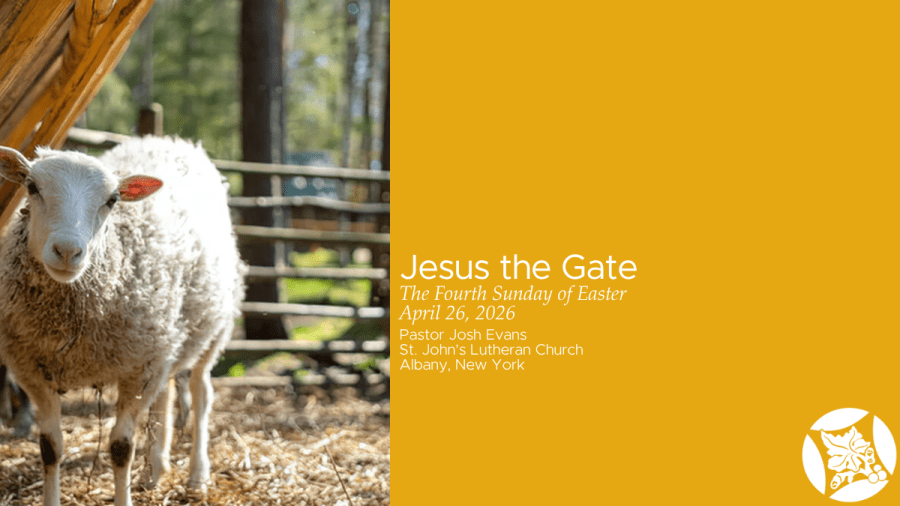
Jesus the Gate
is the invitation and entrance
to abundant life –
for the man born blind,
for the disciples and onlookers listening in,
for anyone who has been the victim of gatekeeping,
for anyone who has been excluded or feels like they are less than.
Jesus the Gate
keeps his sheep safe from harm –
a promise made tangible several chapters later,
when Jesus boldly steps out of the garden,
a sort of buffer between his disciples, still safely inside the fold,
and the soldiers and police who have come to arrest him:
“If you are looking for me, let these people go.”
“This was to fulfill,” the gospel writer parenthetically explains,
“the word that he had spoken,
‘I did not lose a single one of those whom you gave me.’”
There is safety and belonging in the sheepfold.
Where Jesus’ own beloved are driven out,
cut off from community,
and left in harm’s way,
Jesus the Gate offers refuge, belonging, and life abundant.
Jesus the Good Shepherd
is a powerful image –
one that has inspired centuries of hymnody, liturgy, and artwork.
Just as powerful
is Jesus the Gate,
who stands open,
ready to welcome and receive his flock,
no matter who they are,
who calls us by name
and bids us to follow him,
forming communities of care and belonging,
until all can know and experience
the promise of God’s abundance.

