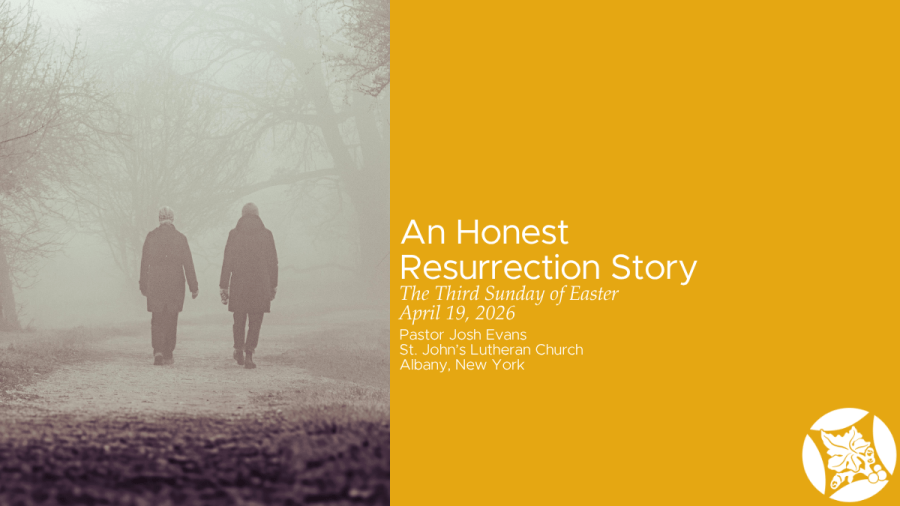
St. John’s Lutheran Church
Albany, New York
19 April 2026 + The Third Sunday of Easter
Luke 24:13-35
The Rev. Josh Evans
“Are you the only stranger in Jerusalem
who does not know the things
that have taken place there in these days?”
Probably not.
Probably not even close.
Crucifixion happened. A lot.
It wasn’t exactly a remarkable or noteworthy occurrence.
Even if word had spread that quickly,
even if this random stranger did know the particulars,
it would hardly have merited a second thought –
except as a staunch warning
of what the empire’s police state was capable of.
But for these two traveling companions,
their grief is real,
their disappointment is real,
their despair is real,
their fear is real –
as they walk along,
trying to make sense of all these things that had happened.
Theirs is hardly an Easter world.
Theirs is a Holy Saturday world:
Jesus is dead, and the tomb is sealed.
The end.
In Luke’s version of the resurrection story,
Jesus hasn’t even shown up yet.
It was only those two mysterious men “in dazzling clothes”
who show up to greet/terrify the women at the tomb
earlier that same day.
There’s nothing beyond the word of these two men
to suggest that Jesus has risen.
For these two disciples on the Emmaus road,
Jesus is, at worst, still dead,
or at best, missing.
Their hopes are dashed.
All the promises they had staked their lives on – gone.
Worse yet, the tomb is empty, and Jesus’ body is missing –
just when it seems like things couldn’t possibly unravel any more.
Where’s the good news in that?
***
Walking along in a fog of grief,
a stranger appears:
“What are you talking about?”
(Can you imagine?
“Are you the only stranger in Jerusalem
who does not know the things
that have taken place there in these days?”
Probably not.)
Jesus’ first post-resurrection appearance
is not a grand or showy moment,
but a moment of quiet accompaniment and curiosity:
“What are you talking about?”
It’s an invitation for them to tell their story,
to name their grief,
to process what they’re experiencing,
to feel what they feel without discounting it
or trying to explain it away.
There is power in naming grief out loud like that.
***
This past week,
as I attended the super-nerdy Institute of Liturgical Studies,
at Valparaiso University in Indiana,
I got to hear in person from one of my theological icons,
Debie Thomas –
she’s practically the free space on my homiletical bingo card.
In Thomas’ workshop,
she encouraged us –
particularly those of us who preach –
to reclaim the practice of lament –
of taking seriously those moments where everything is not okay
and naming those moments out loud, honestly.
There are, of course, myriad impediments to lament in the church:
It’s too “faithless,”
too “emotional,”
too “despairing” –
among a multitude of other reasons.
But what if, Thomas encouraged us to consider,
the permission to lament is a relief?
What if the good news includes lament?
After all, the resurrected Christ had scars
as we heard in last week’s story.
What if we made space for the honesty of “Holy Saturday,”
the space of “already/not yet” where we spend so much of our lives?
Lament is a gift –
neither denying the reality of the hard stuff,
nor offering easy or quick fixes
or false hope.
Lament, when given its space,
can be a powerful thing –
“the first language of the church,”
as Thomas puts it,
but also not its final language.
Lament, when allowed to run its course,
can push back against helplessness,
proclaiming a trust
in “the God of the small things” –
along the road,
around a table,
breaking bread,
inviting dialogue and questions.
***
Here’s the good news I hear this day:
Jesus invites the traveling companions
to name their grief and loss.
He doesn’t seem to care that they don’t immediately recognize him –
or can’t recognize the presence of God in their midst at this specific moment
when grief and trauma keep them from seeing clearly.
Jesus is with them anyway –
already a blessing:
in the walking, on the road, in the listening,
in the grief, in the despair, in the disappointment.
Emmaus is an honest resurrection story,
as – you guessed it – Debie Thomas notes
in an earlier commentary on this text:
“I’m grateful that the journey continues into Easter evening,
when hope is possible but not yet realized.
I’m grateful that even the road to Emmaus –
the road of brokenness, the road of failure –
is a sacred road.
A road that Jesus walks.
A road that honors our deep disappointment,
even as it holds out possibilities of nourishment and revelation.”
Emmaus is an honest resurrection story
for our “Holy Saturdays” –
those spaces of “already/not yet” –
where we spend so much of our lives.
Emmaus is an honest resurrection story
that holds our grief,
makes space for our lament,
invites our questions,
validates our anger.
Emmaus is an honest resurrection story
where it’s okay to not be okay –
and where – all of a sudden – we recognize:
The risen Jesus has been there all along,
alongside us the whole way.

