St. John’s Lutheran Church
Albany, New York
31 May 2026 + The First Sunday after Pentecost: Trinity Sunday
Genesis 1:1—2:4a
The Rev. Josh Evans
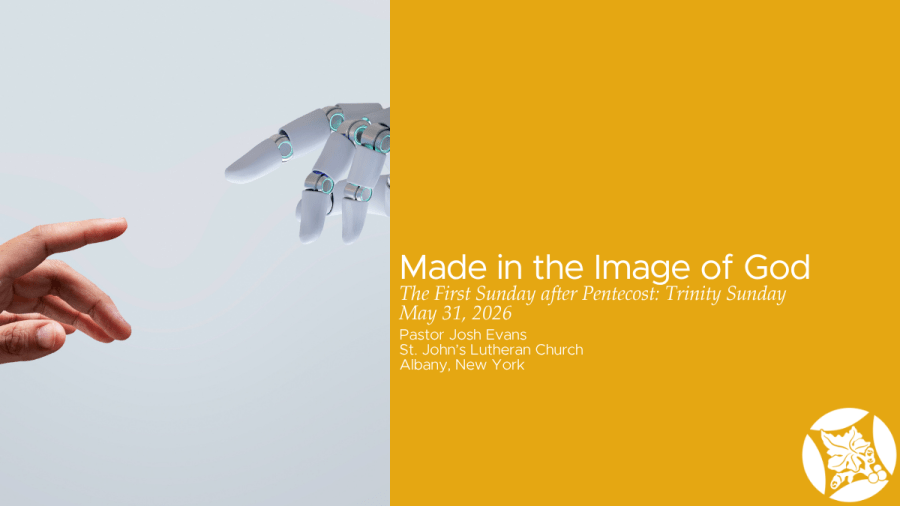
When Glendale Community College’s commencement ceremonies
“hit a snag” earlier this month,
with some graduates’ names being read incorrectly
and others not at all,
college president Tiffany Hernandez explained,
“We’re using a new AI system as our reader.”
Speakers at other commencement ceremonies
have been met with resounding boos from graduates
at the very mention of AI.
“I struck a chord,”
one speaker at the University of Central Florida nervously remarked,
now clearly off-script,
against the backdrop of protests,
including a barely audible but unmistakable “AI sucks!”
from among the student body.
More than just taking away job prospects from graduates
who have invested a great deal of time, labor, and money into their education,
opponents of AI’s largely unregulated rise are also skeptical
and rightly concerned
about its impact on the environment and the economy,
making the rich richer
and depleting precious natural resources
at an alarming rate,
with disproportionate impacts on communities of color. (NPR)
An ever-increasing and nearly inescapable part of our daily lives,
artificial intelligence certainly has its uses –
and its limitations.
The line between fact and fiction,
between truth and “fake news,”
is blurred,
leading us to question what is fabricated
and what is authentic.
Beyond mere limitations,
AI – left unregulated and in the wrong hands –
has dangerous and worrisome implications –
social,
ecological,
and theological.
What then shall we say?
***
Trinity Sunday this year
gives us the full account of the first creation myth from Genesis –
the biblical writers’ attempt to explain the origins of our universe
and everything in it –
at the heart of which is the stunning declaration:
“Let us make humans in our image.”
And it is from this verse which arises
the fundamental Christian doctrine
of imago Dei:
the premise that all humans are created “in the image of God.”
To borrow a well-worn phrase from Luther:
What does this mean?
For starters,
pay attention to the pronouns:
“Let us make humans in our image, according to our likeness.”
Who exactly is God talking to?
A question which becomes even more intriguing
when you realize that “God” here is Elohim –
the Hebrew plural – Gods.
“God: The Original They/Them,”
as one popular sticker declares.
The doctrine of the Trinity –
a mind-numbingly boring phrase I promise not to repeat in this sermon –
is famously difficult, if not impossible, to explain,
with heretical red flags at every turn,
so I’m not going to try to do that here,
except to say this:
This is about the way we relate to and experience God.
God who is Father, Son, and Holy Spirit;
God who is Creator, Redeemer, and Sustainer;
God who is mysteriously One-in-Three and Three-in-One;
God who is “up there, down here, and everywhere.”
There is an intrinsically relational aspect of this God,
and maybe that’s what the (very Jewish) writer of Genesis had in mind
in those first-person plural pronouns –
long before the (very Christian) Trinity became a thing.
If this “we/us/our” is who God is,
then there are implications for who we humans,
created in God’s image, are:
never “I” or “me,”
but “us” and “we.” (SALT)
In the words of the Rev. Dr. Martin Luther King Jr.,
in a quote that hangs on my office wall:
“An individual has not started living
until [they] can rise above the narrow confines
of individualistic concerns
to the broader concerns of all humanity.”
The imago Dei calls us out of our self
into community,
into relationship with our fellow creatures,
not as objects to be owned and exploited,
but as beings, as fragile as ourselves,
to be loved, cared for, and protected.
Against this backdrop,
as artificial intelligence surges,
with far-reaching implications
blurring lines between what is real and what is fake
and exploiting people and planet,
what then shall we say?
***
In his newly released encyclical and the first of his papacy,
Pope Leo XIV’s “Magnifica Humanitas (“Magnificent Humanity”):
On Safeguarding the Human Person in the Time of Artificial Intelligence,”
has a lot to say – about 42,300 words’ worth.
“In recent years,” Leo writes, “it has become increasingly evident how rapidly and profoundly digitalization, artificial intelligence (AI) and robotics are transforming our world. Technology should not be considered, in itself, as a force antagonistic to humanity… Over the centuries, technological development has significantly improved the living conditions of humanity. At the same time, each phase of progress has also revealed the ambiguity of tools that can cause harm when not oriented toward the good.” (4)
Take, for instance, the story of the Tower of Babel,
the first of two biblical images Leo lifts up to ground his letter in scripture:
“It was an impressive feat:
a single language, a single technology, a single direction”
but “conceived without reference to God,
supported by a uniformity that eliminated diversity
and that chose homogenization over communion.”
The result? Dispersion, rather than unity. (7)
By way of counter-example,
Leo points to the rebuilding of Jerusalem,
as recorded in the book of Nehemiah,
following the devastation of the Babylonian exile.
Through prayer and fasting,
careful listening and coordination,
“the city is reborn…
through the shared responsibility of all…
an undertaking with God at the center,
which rebuilds relationships before rebuilding with stones.” (8)
Thus Leo summarizes his central thesis:
“Technology has the power to heal, connect, educate and protect our common home; but it can also divide, exclude and generate new forms of injustice. In the abstract, technology in and of itself is not a solution to humanity’s problems, just as it is not inherently evil. In practice, however, technology is never neutral, because it takes on the characteristics of those who devise, finance, regulate and use it. Therefore, the primary choice is not between a ‘yes’ or ‘no’ to technology, but rather between constructing Babel or rebuilding Jerusalem; between a power that claims to dominate the heavens and a people who work together in the presence of God to rebuild the walls of fraternal coexistence.” (9)
At the heart of Leo’s encyclical is also an appeal
to the social teachings of his church,
beginning with a re-affirmation of the heart of the Christian faith:
“the mystery of the living God, revealed in Jesus Christ, who, as a communion of Persons — Father, Son and Holy Spirit — is love itself in relationship, expressed in the mutual gift of self and in sharing with the world.” (48)
And it is in the image and likeness of this Triune God –
love itself in relationship –
that we humans are created.
Leo does not dismiss or condemn the use of technology,
but consistently calls us back to our humanity
as we consider the implications of that technology
and how we choose to shape it in our lifetime
and in lifetimes to come:
“We can embrace the technological progress that alleviates suffering and unlocks new possibilities, provided that we do not abandon the very essence of our humanity, namely the capacity for relationship and love.” (126)
Relationship and love –
this is the core of who God is,
in whose image we are made.
Made in the image of God,
relationship and love
is the core of what we are called to embody.
This is the starting place.
From this flows our faithful response,
not just to AI and ever-evolving technology,
but in all we say and do
in loving service to the world and our neighbors,
as together we live out our baptismal covenant
“to strive for justice and peace in all the earth” –
grounded in love
and rooted in relationship.
***
What then shall we say?
There is nothing artificial about God’s love.
And there is no artificial replacement for what we do here:
gathered with fellow, living, breathing creatures
made in the image of a God who loves us
and calls us “very good,”
nourished by word and sacrament,
and sent to bear God’s creative, redeeming, and life-giving word
to all the world.
We who are made in the image of God
bear the image of a God who is in relationship with God’s self
and, most importantly, in relationship with humanity:
a God who carefully created us out of the dust of the ground
and lovingly breathed into us the breath of life;
a God who took on our flesh
and came to dwell with us in the person of Jesus,
who himself breathes into us the gift of the Holy Spirit, our Advocate;
a God who refuses to remain distant,
“up there, down here, and everywhere”;
a God who calls us out of our self
into community,
into relationship with our fellow creatures,
for the care of our common home
and for the sake of the common good.

