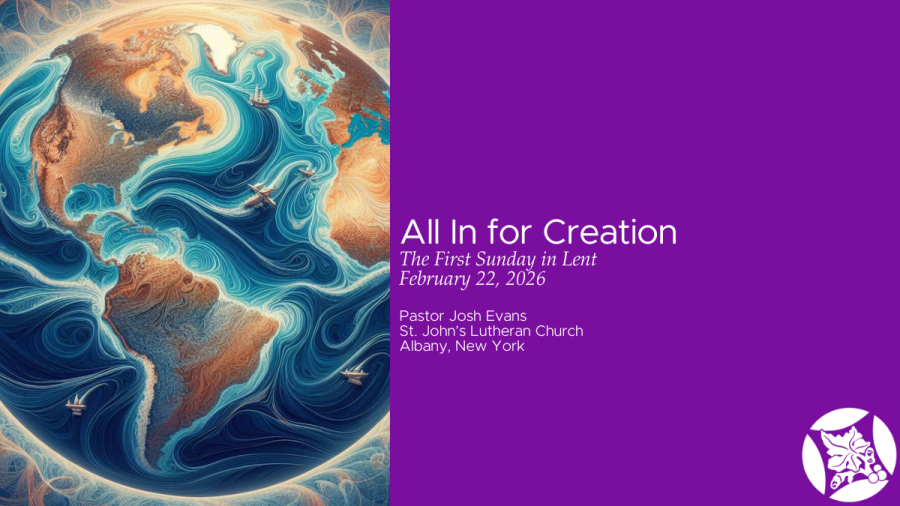
St. John’s Lutheran Church
Albany, New York
22 February 2026 + The First Sunday in Lent
Genesis 2:15-17; 3:1-7; Matthew 4:1-11
The Rev. Josh Evans
Since its inception in 1947,
the so-called Doomsday Clock,
an initiative of the Bulletin of the Atomic Scientists,
has served as a clever, if not ominous, visual,
warning the public about how close we are
to destroying our planet
with dangerous technologies of our own making.
It is, in the Bulletin’s own words,
“a metaphor [and] a reminder of the perils we must address
if we are to survive on the planet.”
The clock’s hand first moved in 1949,
after the then-Soviet Union successfully tested its first atomic bomb,
from its original seven minutes
to three minutes to midnight.
It has fluctuated back-and-forth several times since then,
over the course of its nearly 80-year history.
In 1991, by the end of the Cold War,
the clock’s hand rested at 17 minutes,
the farthest it’s ever been from midnight
Since that time, the clock has ticked steadily closer,
hand-in-hand with an increase in nuclear tests around the world
and the failure of countries to adequately address climate change.
Most recently, on January 27, 2026,
citing fracturing global politics and a collapse of long-held alliances,
the rise of nationalism favoring competition over cooperation,
the ongoing risks of nuclear war and climate change,
the misuse of biotechnology,
and the threats posed by our ever-increasing reliance on AI,
the clock was advanced yet again:
85 seconds to midnight.
Dismissed by some as a scare tactic
or a clever device towards advancing a particular partisan agenda,
the scientists behind the clock are adamant:
Their warnings are not politically motivated,
but rooted in the survival and flourishing of the human species –
and the impact of that human species on the very planet we call home
is becoming increasingly difficult, if not impossible, to deny and ignore.
***
More than simply a scientific issue,
it is also a theological one –
and, at least in part, the focus of the “purple hymnal,”
All Creation Sings.
“Recent years have seen a rapid increase in awareness and alarm,” the hymnal editors write in their introduction, “concerning the impact of human activity over the past two hundred years on this planet’s ability to sustain the fragile balance necessary for the life God planted here, including human life. East Sunday as God’s people are gathered into and sent from worship, All Creation Sings reminds us how we are integrally part of the whole of creation, marvels at the gifts of creation, and gives thanks for the grace to join the rest of creation’s song even as the cosmos joins ours.” (p. 5, emphasis mine)
It’s no surprise, then,
that the pages of ACS are filled
with such songs in praise and thanksgiving for creation –
as well as lament for the ways creation groans in pain and pleading.
“Can you feel the seasons turning,”
asks one such hymn (ACS 1065),
“winds and waves grown wild and strange?
Can you feel creation groaning,
fearful of the coming change:
icecaps melting, oceans rising, homes and habitations lost?
Can you feel the seasons turning?
Can you count the bitter cost?
“Can you hear the creatures crying –
lynx and otter, wolf and whale?
Can you hear the Spirit sighing
as her children grieve and fail?
Nature’s poor, the first to suffer,
pay the price of human greed.
Can you hear the creatures crying,
begging us to stop and heed?
“Can you feel the seasons turning?
Storm clouds gather in the skies.
All around us signs of warning
bid us open frightened eyes.
Called by God to serve as stewards
till earth’s garden greens and thrives,
can we learn in time to listen?
Can we turn and change our lives?”
***
Called as the first stewards and caretakers of creation in Eden,
I imagine Adam and Eve grappled with such questions
in the gathering storm clouds of temptation
and its repercussions.
Traditional interpretations of Eden
focus on the sin of disobedience –
and that’s surely worth noting –
but also worth paying attention to
is the slow rift with creation itself.
As one writer astutely observes,
“Before any fruit is consumed, the humans’ relationship with creation begins to shift from cooperative to extractive, and all it takes is a few well-placed words from the serpent.” [1]
How can I benefit from this fruit?
(“Your eyes will be opened…”)
If I eat it, what can it do for me?
(“You will be like God…”)
Even in the panicked scramble for fig leaf coverings,
it would seem the humans are again taking from the garden
for their own benefit –
to attempt to cover up their shame.
Beyond a mere cautionary tale or origin story,
let alone one that would later be used to set the scene for Jesus –
when viewed through the lens of creation itself
and not merely humanity’s comparatively small place in it,
this story becomes instructive for us,
who, so many years later, have only honed the fine art of extraction,
fueling an unquenchable greed for “more”
and further fracturing our relationship with creation
and our fellow creatures – “nature’s poor, the first to suffer” –
and our creator.
What now?
Confession is always a good place to start.
***
On Ash Wednesday,
we engage in one of the most extended rites of confession
of the whole liturgical year, as we pray:
“Our neglect of human need and suffering,
and our indifference to injustice and cruelty…
Our waste and pollution of your creation,
and our lack of concern for those who come after us,
we confess to you.
Have mercy on us, O God.” (ELW, p. 253)
And in the words of the Great Litany,
as we sang moments ago,
we implore God to hear us as we pray
“to help us use wisely the fruits and treasures
of the earth, the sea, and the air.” (ELW 238)
Our Lenten liturgy calls us not to repentance for repentance’s sake,
but back to the life our creator intended:
“to experience joy in communion with God,
to love one another,
and to live in harmony with creation” –
for the flourishing of all.
Instead of extraction,
we can follow the example of Jesus in the wilderness,
“tempted in every way as we are,”
who not just once, but three times (a good, symbolic number, to be sure),
turns down the allure of quick, easy fixes,
choosing instead “repair, reverence, and humility,”
as one commentary puts it,
“instead of pushing the limits of what God’s creation can do for him.” [2]
Jesus offers us a way of being that reminds us
how God is – cue the Lenten theme –
all in for creation –
all of it –
the human parts
and the non-human ones.
This is about redemption,
not retribution,
and about how God in Christ has reconciled the world
[the cosmos, the entire created order]
to God’s self.
In confession,
we acknowledge the reality and gravity of our sin –
the evil we have done and the evil done on our behalf –
towards one another and towards the planet
for our own selfish and extractive gain.
But confession is never for confession’s sake alone.
In confession,
we also receive God’s word of forgiveness
and are reminded, time and again,
that God is all in for us
and for all creation.
Sustain us in our Lenten pilgrimage,
we pray,
calling us to go all in on the life our creator intended:
in harmony with creation,
in relationship with one another,
caretakers of our common home,
“till earth’s garden greens and thrives”
in the renewing waters and new life of Easter joy.
[1] Linnéa Clark, February 22, 2026: First Sunday in Lent, All In: Preachers’ Notes (Barn Geese Worship, 2025), 7.
[2} Ibid., 8. Emphasis mine.
 Pastor Josh Evans