St. John’s Lutheran Church
Albany, New York
18 February 2026 + Ash Wednesday
Joel 2:1-2, 12-17
The Rev. Josh Evans
Twice in my life have I read the book of Joel in its entirety –
which is less impressive when you realize
it’s only three chapters long.
The first was during study hall in high school –
yes, I was that cool –
when I either blissfully had no homework to do,
or, more realistically, was procrastinating all the homework I still had to do.
The second was yesterday,
as I was preparing this homily.
Because, let’s be real,
how many times can you possibly preach
on the absurdity of reading a gospel text
that tells us to “beware of practicing your righteousness before others”
when we go on to do just that,
marking ourselves with thick, black, oily ashes
in the most conspicuous place possible.
Joel is a fascinating little book –
one that lacks not only specific authorship,
but also specific timing.
And unlike the other prophets,
Joel also never accuses God’s people of any specific sin
but rather assumes you know
because, like the author(s) of Joel,
you’ve read the other prophets
to whom Joel alludes quite a bit.
What Joel does do in no uncertain terms
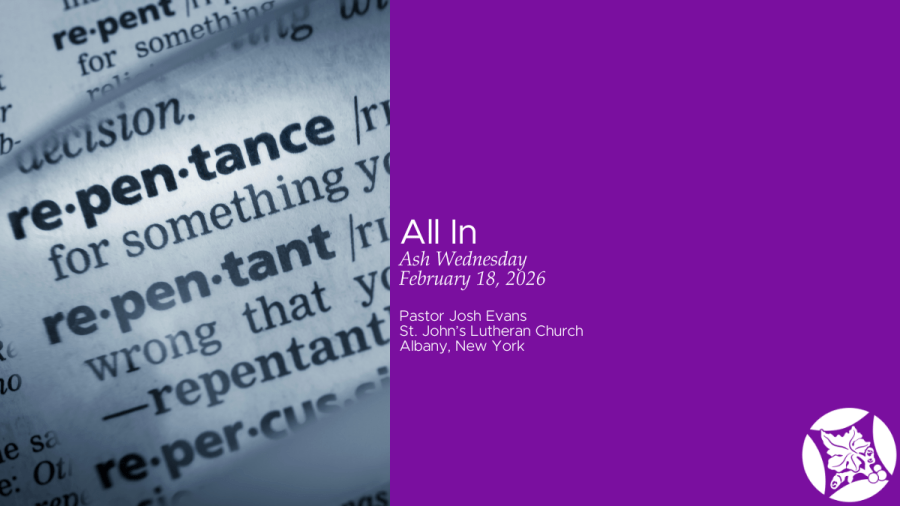
is call the people to repentance –
which is, perhaps, why we get Joel on Ash Wednesday,
at the beginning of a season that calls us to repentance.
The call of the prophet Joel urges us
to go all in for repentance:
“Rend your hearts and not your clothing,”
Joel declares.
Translation:
“Repentance can’t just be a show
you put on to get out of trouble.”
Joel calls us to go all in for repentance,
all of us:
the aged and the children,
even infants at the breast,
the bridegroom and the bride,
even the priests and the ministers,
the whole congregation and all the inhabitants of the land,
the ones who are usually here
and the ones who aren’t –
no one is exempt.
Joel calls us to go all in for repentance…
but missing from our reading today,
indeed in the very next verse(s) if we had kept reading,
is God’s equally profound response –
going all in for mercy:
“Then the Lord became jealous for his land
and had pity on his people…
Do not fear…
be glad and rejoice,
for the Lord has done great things” –
complete with promises of restoration
and visions of plenty –
and perhaps my favorite verse in all of Joel,
from the time I first read it in high school study hall:
“You shall know that I am in the midst of Israel,
and that I, the Lord, am your God and there is no other.
And my people shall never again be put to shame.” (Joel 2:27)
“Where is their God?”
Right here, in our midst.
Joel calls us to go all in for repentance
because Joel trusts that on the other side of repentance
is a God who stands ready to forgive,
“gracious and merciful…
abounding in steadfast love” –
a God who goes all in for us
because that’s how much God loves us –
a God who is unwilling to give up on us
and unwilling to let us give up on each other.
The repentance we are called to,
as one commentary puts it,
is “a transformative turning”
with “interpersonal implications.” [1]
In other words,
it’s less about our own personal piety and screw-ups
and more about how we live in relationship with others.
Rend your hearts and not your clothing…
“When practiced genuinely,”
the commentator reminds us,
“repentance has the ability to reform relationships,
heal harms, and make a better way for the future.
When we take the call to repent seriously…
it has real-world impacts.” [2]
“Christianity is a simple religion,”
reflects Texas state representative and Presbyterian seminarian James Talarico
in an interview this week on the Late Show,
calling to mind words his South Texas Baptist preacher grandfather
often shared with him.
“Not an easy religion
but a simple religion,
because Jesus gave us two commandments:
Love God and love neighbor.
And there was no exception to that second commandment.
Love thy neighbor regardless of race or gender or sexual orientation
or immigration status or religious affiliation.”
“Don’t tell me what you believe,”
Talarico says.
“Show me how you treat other people,
and I’ll tell you what you believe.”
Rend your hearts and not your clothing…
This is repentance:
when we turn toward God
and toward God’s ways,
toward love for our neighbor
and care for creation,
toward accepting “the freedom and power God gives us
to resist evil, injustice, and oppression
in whatever forms they present themselves,”
to borrow words from our United Methodist siblings
in the baptismal covenant liturgy,
words I was reminded of this week in conversation with colleagues.
Repentance is, ultimately,
as one writer puts it,
“a homecoming…
a return to God…
a return to the one who loves us,
who never leaves us,
who will always receive us” [3] –
just as the prophet Joel reminds us –
a return to the one who has gone all in for us
and who yearns for us to go all in for one another in love.
Rend your hearts and not your clothing…
It was never just about the ashes.
It’s about love –
to love fiercely and extravagantly,
as God has first loved us,
for the sake of our neighbor
and for the sake of the whole creation.
[1] All In: Preachers’ Notes, February 18, 2026: Ash Wednesday, by Emily Trubey-Weller. © 2025 Barn Geese Worship. Used by permission.
[2] Ibid.
[3] Ibid.
 Pastor Josh Evans