St. John’s Lutheran Church
Albany, New York
15 February 2026 + The Transfiguration of Our Lord
Matthew 17:1-9
The Rev. Josh Evans
It begins with a question: “Who do you say that I am?”
Which prompts Peter’s bold confession: “You are the Messiah.”
Well done, Peter!
But when Jesus starts explaining what exactly it means
for him to be the Messiah –
that he will undergo great suffering and even be killed –
Peter rushes to his defense: “God forbid it, Lord! This must never happen to you!”
Which, in turn, prompts Jesus’ infamous words: “Get behind me, Satan!”
And Jesus continues in his explanation of what it means
for him to be the Messiah –
and even the implications for his followers:
“Let them…take up their cross and follow me.”
Turns out, this following Jesus thing is not going to be easy.
Peter alone was bold enough to confess Jesus’ messianic identity.
Did Peter really not know what it meant though?
Or maybe he knew exactly what it meant –
and so he tried everything in his power to stop it from happening.
“You’re going to do what, Jesus? God forbid it!”
And then, six short days later,
they’re on the mount of Transfiguration,
and Peter sees his opportunity again:
“This is great! Let’s build some tents and stay a while…
like how about forever?
Forever would be good.”
I suspect Peter knew exactly what it meant
for Jesus to be the Messiah,
or at least had a pretty good idea,
and he knew exactly where the road to Jerusalem would ultimately lead.
He just wanted to preserve the good thing he had
a little while longer.
Peter wanted to stay,
to keep things exactly how they were –
and truthfully, who can blame him?
***
With every passing Transfiguration Sunday,
and with every passing news story,
more and more, I get where Peter is coming from.
The temptation to stay where everything is good and safe,
to insulate ourselves from all that seeks to harm us and those we love,
to pretend like it doesn’t exist and to build for ourselves tents of security,
is certainly strong.
I get it.
Peter had every reason to be afraid
and every right to want to hold on.
And then, all of a sudden,
comes a bright, overshadowing cloud
and a disembodied voice (is it God?):
“This is my Son, the Beloved; with him I am well pleased; listen to him!”
(Where have we heard that before?)
Matthew tells us the disciples were “overcome by fear.”
No kidding.
And so afraid, in fact, that they fell to the ground –
physically paralyzed by their fear.
It’s quite an experience to be overcome by an emotion that intensely –
be it fear, or grief, or anxiety.
It’s the only thing we can think about in the moment.
It’s got a grip on us that won’t let go.
It feels impossible to do anything else.
It might even feel as though we’re suffocating.
In the midst of the disciples’ intense fear,
Jesus offers a surprising and gentle act of grace.
“Jesus came…and touched them.”
Jesus doesn’t berate the disciples for their fear.
There is no “Get behind me, Satan!” here.
Nor does he judge them.
For as much illumination is present in today’s gospel story,
the shadow of fear is just as real and just as present
in the lives of Jesus’ friends.
That fear was surely more than just from the drama of the present moment.
After all, Jesus had just been explaining to them
how being the Messiah meant that he would soon suffer and die –
and that very likely his disciples would too –
just for being associated with him.
What had they gotten themselves into?
Jesus reaches into that fear and touches them,
perhaps an act of blessing,
certainly an act of compassion.
I imagine Jesus’ outstretched hand,
reaching out to his friends huddled in their fear on the ground.
He doesn’t forcefully grab them by the cloak and yank them back up.
But he calmly, patiently, gently takes hold of them
to help them back on their feet.
“Get up
and do not be afraid.”
***
Do not be afraid.
Where have we heard that before?
“Joseph, son of David, do not be afraid…”
the angel whispered,
though, in fact, Joseph had every reason to be afraid –
afraid of what would happen to his pregnant fiancée
and what could even happen to him by association.
In the midst of Joseph’s intense fear,
he is met with a promise:
“Do not be afraid.”
The child will be Emmanuel –
God with us.
This child would grow up
to embody Emmanuel –
to remind his people
that God is with them.
On the mount of Transfiguration,
this now fully grown Emmanuel stoops down
and reaches out to his friends in their intense fear
with the same words of promise
that have been present in this gospel story since the very beginning:
“Do not be afraid. I am with you.”
***
In the midst of Joseph’s fear
is a blessing and a promise.
In the midst of Peter and the disciples’ fear
is a blessing and a promise.
Jesus frees his disciples from their fear
so that they can face the journey back down the mountain
and the road that lies ahead –
confronted almost immediately by a crowd
and a father whose son is severely ill.
What is most intriguing to me, though,
in the scene that follows,
is not the miraculous healing,
but Jesus’ almost tongue-in-cheek frustration,
directed at his disciples who tried (and failed) to cure the boy themselves.
“How much longer must I be with you?”
Jesus sighs in exasperation,
just before finally healing the boy himself.
I can’t say for certain what Jesus meant by that question,
and I could totally be making this up
and reading into Jesus’ words what I want to hear (and preach).
But reading this story in the context of the whole of Matthew’s gospel:
Those words seem like more than just a coincidence.
Matthew’s gospel is a story that begins with the promise of Emmanuel
and the encouragement: “Do not be afraid.”
At every turn,
and most dramatically and tenderly at the center of the Transfiguration story,
Matthew’s gospel reverberates
with the experience of Emmanuel.
Now, as Jesus sets his face toward Jerusalem,
toward his own suffering and death, he asks:
“How much longer must I be with you?”
Matthew’s gospel story doesn’t end there,
but with a decisive answer to that very question,
on another mountain,
just before Jesus’ ascension:
“I am with you always, to the end of the age.”
How much longer?
How about forever.
***
In the midst of Peter and the disciples’ fear
is a blessing and a promise.
In the midst of our fear –
and goodness knows there is more than enough to go around –
is a blessing and a promise.
Even when we are huddled on the ground in our fear,
Jesus stoops down to us
and reaches out a patient, gentle hand,
in compassion and blessing,
to help us get back on our feet.
Jesus frees us from our fear –
frees us for the journey back down the mountain,
for the work of ministry in increasingly challenging times,
and empowers us to boldly proclaim,
in the words of that marvelous Puerto Rican theologian
Benito Antonio Martínez Ocasio –
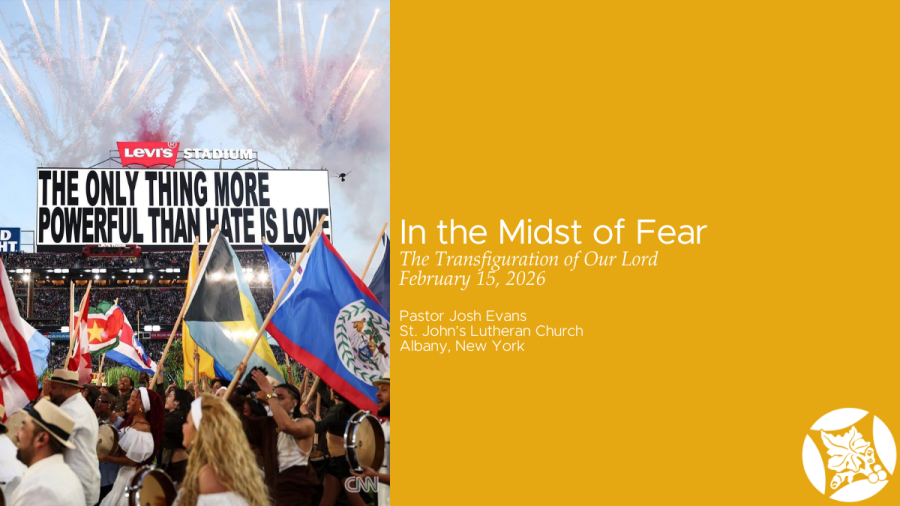
maybe you tuned in to his halftime performance last Sunday night –
“The only thing more powerful than hate is love.”
Indeed,
in the midst of fear,
and hate, and bitter division,
this is our calling:
To love
and to love fiercely.
And through it all, Jesus promises us:
“Do not be afraid. I am with you.”
 Pastor Josh Evans