St. John’s Lutheran Church
Albany, New York
18 January 2026 + The Second Sunday after the Epiphany
Lectionary 2a
John 1:29-42
The Rev. Josh Evans
Who is Jesus?
A loaded question if ever there were one.
It’s also the question the gospel writer puts before us today.
Instead of one, neat answer, though,
we get several.
And in fact, the entire first chapter of John’s gospel
seems to be preoccupied with answering that question.
Jesus is “the Word” who was with God and was God in the beginning.
Jesus is “the true light” which enlightens everyone.
And perhaps most scandalous of all,
Jesus is not only the eternal Word who is and is with God,
but this Word is also human, taking on our flesh to live among us.
It’s worth noting, by the way,
that all of this precedes any appearance of Jesus himself.
And still, there’s more:
As John the Baptist proclaims:
“Here is the Lamb of God!”
Maybe, as one commentary offers,
John was thinking of the Passover lamb,
slaughtered by his ancestors in ancient Egypt
and whose blood was painted on their doorposts
as a visible sign of protection from the tenth and final plague.
Or maybe his hearers thought of Isaiah’s Suffering Servant,
“like a lamb that is led to slaughter,”
whose life was made “an offering for sin.”
Or maybe a foggy mix of both.
But in either case, Jesus “the Lamb of God”is understood to be someone
who will protect, provide, and even intervene for God’s people.
Then, recalling the earlier episode of Jesus’ baptism,
John is bold to further assert that this Lamb of God is also the “Chosen One” –
literally, in the Greek, the “Son of God.”
John is clear that Jesus has a special relationship with God –
and, indeed, as we already know from verses before, is himself God,
as the Fourth Evangelist confesses.
It is these two descriptors of Jesus
as the “Lamb of God” and the “Son of God”
that are enough to prompt two of John’s disciples to begin following Jesus.
And who can blame them?
It certainly sounds intriguing, if nothing else.
“Rabbi,” they call him.
They want to learn from Jesus the teacher
because they recognize that there might be something worth learning from him.
Interestingly, in John,
it is not Jesus who explicitly calls the first disciples.
It’s another disciple, Andrew, who invites his brother Simon Peter:
“We have found the Messiah.”
The “anointed” one. Another answer to the question of Jesus’ identity.
Is he the heir to King David
who will restore and rescue the kingdom of ancient Israel?
There is great hope in Andrew’s declaration,
and it’s enough to pull Simon Peter along for the ride.
Who is Jesus?
There’s really no easy answer to that question
in this first chapter of John,
and in fact, there are many answers,
depending on who you ask:
Word, Light, Lamb of God, Son of God, Rabbi, Messiah.
Who is Jesus?
Perhaps the most profound answer to that question
is another question – and an invitation – from Jesus himself,
when he finally gets a chance to speak…38 verses in:
“What are you looking for? Come and see…”
Who is Jesus?
The answer Jesus gives is not a didactic lecture,
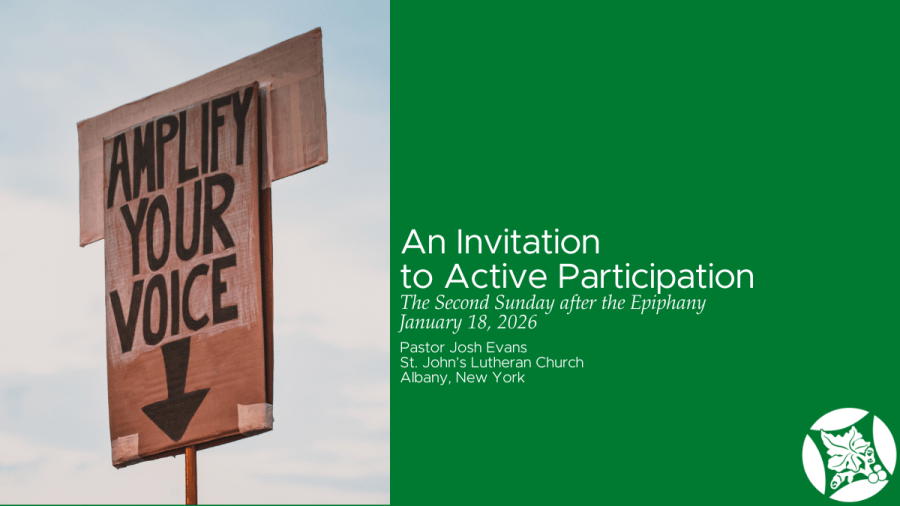
but an invitation to active participation.
Who Jesus is
lies in what Jesus is calling his disciples to do.
“You want to know who I am, where I’m staying, and what I’m up to?
Come and see…
Come and find out for yourselves…”
Who is Jesus?
There is no easy answer here,
but instead, an invitation to active participation.
***
We got a reminder of what that active participation looks like
last Sunday as we baptized Eli and welcomed him into the family of God,
as his parents and sponsors made promises on his behalf,
reminding us of our own baptismal covenant:
“to live among God’s faithful people,
to hear the word of God and share in the Lord’s supper,
to proclaim the good news of God in Christ through word and deed,
to serve all people, following the example of Jesus,
and to strive for justice and peace in all the earth.”
We get a reminder of what that looks like
every year as we commemorate the Rev. Dr. Martin Luther King Jr.,
preacher, activist, community organizer,
renewer of society, and martyr,
whose passion for racial and economic justice
continues to inspire us to faithfully bear witness
to God’s vision for Beloved Community
even and especially in increasingly troubling and scary times.
We get a chance to practice what that looks like
as active and engaged citizens,
compelled by our faith
and rooted in the social teachings of this church:
to stand in solidarity with our siblings in Minneapolis
standing up to racist, xenophobic rhetoric and acts of violence;
to write to, call, and urge our elected representatives,
in Colonie, in Albany, and in Washington,
to embody mercy and care for our neighbors,
enacting legislation and policies
that clothe, feed, protect, and uphold the dignity of all.
***
I hardly think Andrew, Simon Peter,
and those first disciples to follow Jesus
knew exactly what they were in for.
Even with John the Baptist’s bold testimony,
they still had only just met Jesus.
They hardly knew who he was,
let alone what he was about to do.
They certainly could never have predicted it would lead to the cross.
“You want to know who I am? Come and see…”
Learning who Jesus is, really is,
meant having to get up and get out of their comfort zones,
going to places unknown, and taking risks.
As they would soon learn:
Following Jesus is going to be uncomfortable.
And if it feels otherwise, we’re doing it wrong.
Let me say that again:
Following Jesus is going to be uncomfortable.
And if it feels otherwise, we’re doing it wrong.
Following Jesus means hearing the Word –
and then doing it –
taking the faith we profess, and pray, and sing in these pews
into the streets, into our lives, into our communities,
and making a difference.
***
So, who is Jesus?
Word, Light, Lamb of God, Son of God, Rabbi, Messiah…
yes, and:
Jesus is someone who has done the hard things,
challenged the status quo of a mighty powerful and threatening empire,
and made it through on the other side,
insisting there is another way,
and empowering us to do the same.
Because Jesus has been to the places of pain and suffering,
we are compelled to go there too.
Because Jesus took risks for the sake of the gospel,
we can take risks for the sake of our mission too.
Because Jesus caused trouble,
we can join the trouble.
Because we know that Jesus has been there (wherever “there” is),
and that Jesus is with us still.
And because the answer on the other side of “come and see”
is full of promise:
liberation,
freedom,
resurrection,
and Beloved Community.
As Jesus himself has promised,
at the heart of John’s gospel:
“I came that they may have life and have it abundantly.” (John 10:10)
Jesus invites us who are his disciples to “come and see” –
to be active participants in his gospel mission.
Jesus doesn’t promise it’s going to be easy,
nor does he give us all the answers.
Instead, he invites us into the mess and the trouble…
and he promises to be right there with us
through it all.
 Pastor Josh Evans